
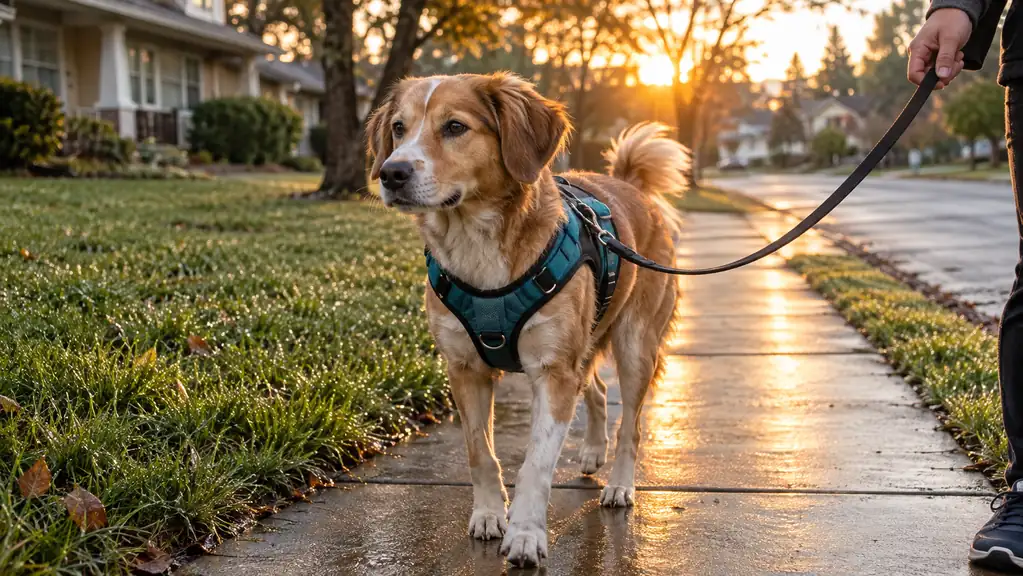
Murphy is a 28 pound beagle mix with a nose that overrules every command I have ever taught him. For the first two years I had him, I walked him on a plain flat buckle collar. Every time he caught a scent he hit the end of the leash and made a sound I did not like, a sort of strangled wheeze, and then he would cough for the next ten steps. By the time we got back to the driveway my right shoulder ached and I was the one who needed to sit down.
In March 2026 I bought the rabbitgoo No Pull Dog Harness in size Medium and put that collar in a drawer. It has been on Murphy for every walk since, two a day, about thirty minutes each, plus the longer loop out at the county park on weekends. Eight months is long enough to know what a piece of gear actually is. Here is the honest version, including the parts of this rabbitgoo harness that are not perfect.
The Quick Verdict
Within about two weeks the hard lunges were gone and my shoulder stopped aching on the walk home. Murphy still leans into the leash when a scent takes hold, and I check the straps every few outings. If this harness wore out tomorrow I would order the same one.
Amazon Check Today's Price →The one piece of gear I would replace first if it broke
Size Medium, front and back leash clips, four adjustable straps. We followed the size chart to get the fit right rather than guessing. Check today's price on Amazon.
Amazon Check Today's Price on Amazon →How I've Used It
I clip the leash to the front chest loop for neighborhood walks. That is the whole point of the design and it is the change I noticed first. The idea is that when Murphy surges forward, the leash pulls him sideways instead of letting him lean into the pressure, so he cannot get his weight behind the pull. I am not a trainer and I am not going to pretend I understand the mechanics better than that. What I can tell you is what happened on our street.
There is one morning in April I still think about. It was a Tuesday, a little before seven, and Murphy caught the scent of something in the hedge two doors down. On the collar he would have gone straight at it and I would have gone with him, because that is exactly what used to happen. On the front clip he turned sideways instead, put one paw up on the grass, and stood there huffing while I got my feet under me. He did not get to the hedge. I did not get hauled off the sidewalk. That was the morning I stopped thinking of the harness as a purchase and started thinking of it as the thing that gave me my walks back.
For the first week he was confused by it. He would start toward a mailbox and sort of spin a quarter turn instead, then look back at me like I had moved the mailbox. By the second week the hard, teeth-bared lunges had mostly stopped. He still pulls. Let me be clear about that, because a review promising that a dog stops pulling entirely is not describing a real dog. Murphy still leans into the leash when he catches something good, but it is a lean now instead of a jolt, and I can hold it one-handed without bracing.
At the county park on Saturdays I clip to the back loop instead. The back clip sits between his shoulder blades and gives him more room to move his front legs, which is what you want when he is ranging out on a longer line. The front clip is for steering. The back clip is for letting him be a dog. Having both on one harness means I am not swapping gear between the sidewalk and the trail.
What the Two Clips Actually Do
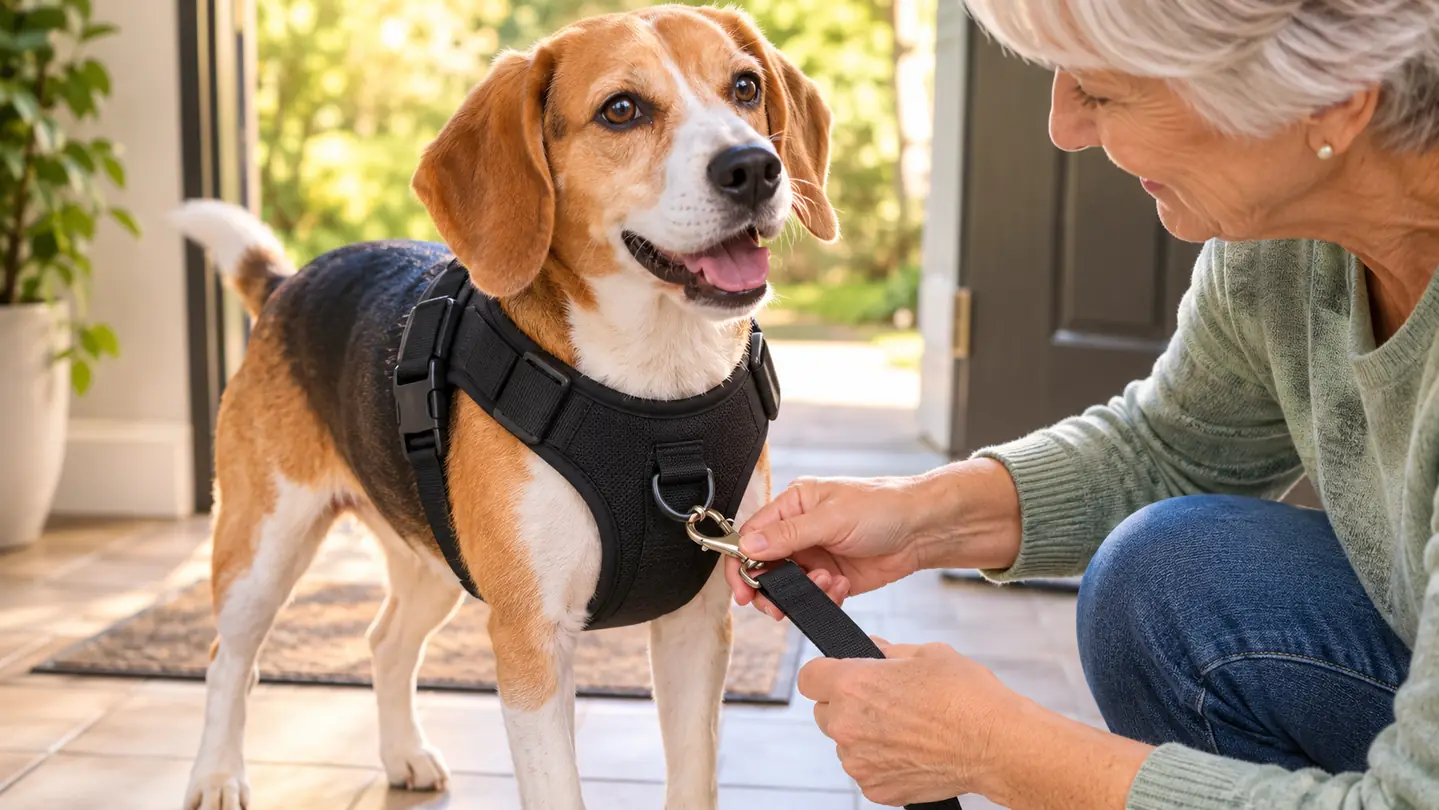
Both attachment points are metal hook loops, not fabric loops, and that matters more than I expected. The old collar had a plastic slide that had worn shiny at the edges. These loops are solid, and after eight months of daily use there is no bending and no visible wear at the metal.
The front clip is the one that changed our walks. When the leash goes taut on the chest, Murphy's front end turns toward me. He cannot drop low and set his weight the way he could on a collar, so the lunge becomes a wide step to the side. It does not stop him wanting the smell. It stops him from being able to drag me to it.
One detail I did not expect: the front loop sits high enough on the chest that my leash clip does not knock against his front legs. On the old collar the clip bounced against his throat with every step and he hated it, which I did not realize until it stopped. If your leash has a heavy brass clip you will feel it swinging when the line is slack, and that is a small annoyance I noticed for about a month and then stopped noticing.
The back clip is the one I use when I want him to have a normal walk. I found the front clip a little awkward at the park, because every time he ranged out the leash pulled him around in a slow circle. That is the trade. Front clip steers, back clip walks. Two clips are genuinely two harnesses in one, and I use both of them every week.
Getting the Fit Right With Four Straps
The harness has four adjustable straps and a buckle closure, and the fit is entirely in those straps. We followed the size chart rather than guessing, and I measured him the way the chart said to with a soft tape. If you are between sizes, go get the measurement instead of the guess. A loose harness on a puller is worse than no harness, because the whole thing rotates when the dog surges.
My first attempt was too loose. I had left the neck straps where they came out of the box and the chest straps maybe an inch out from snug, and on that first walk the whole harness rotated a quarter turn every time he surged. The front loop slid down toward his armpit and the steering went with it. That is the mistake I would warn anyone about. The front clip only works if it stays high on the chest, and it only stays high on the chest if the neck straps are right. Counting the buckle holes so both sides match sounds fussy and takes about two minutes.
It took me three tries over the first week to get it right. The chest straps need to be snug enough that the front clip does not slide down toward his belly, and the neck straps need enough room that the mesh is not pressing on his throat. Once I had it set, I tied a small knot in the loose strap ends so I could tell at a glance if anything had slipped. In eight months I have re-adjusted twice, both times right after a hand wash.
Murphy is 28 pounds and the size chart put him in a Medium by chest measurement. That is why I say measure instead of guessing, because his chest is deep for his size and a size picked by weight alone would have been wrong on him. We went by the chart, and the chart was right.
The buckle closure is a single clip on the back, and I can fasten it one-handed while he does his impatient dance by the door. Off is the same motion. That sounds like a small thing until you have wrestled a harness with three clips over a dog's head at 6:30 in the morning. There is no step-in and no over-the-head with this one, just the buckle, and Murphy has never once fought me on it.
The material is polyester with breathable mesh panels through the chest and back. Murphy runs warm, and in July and August he was no more miserable in this than he is in his own skin. The mesh also dries fast, which I appreciate, because he finds every puddle between here and the corner.
After Eight Months: What Held Up and What Didn't
I wash it by hand in the sink about once a month and hang it to air dry. That is the whole of my maintenance routine. What I have noticed is that the mesh has stayed soft with no pilling on the chest panel, and the stitching around the front metal loop, which takes the most strain, is intact. I expected that seam to be the first thing to go. It has not.
Washing is a sink job. I use a little dish soap, rinse until the water runs clear, and hang it over the back of a kitchen chair. It is dry by the morning walk. The one thing I would tell you to watch is the loose strap ends. They are long, and if you do not tuck them or knot them they flap against the dog's side, which Murphy finds irritating and tells me about. A small knot in each end fixed it and I have not thought about it since. After each wash I check that all four straps still have at least an inch of tail past the buckle.
What has changed: the straps have picked up a soft fuzz where the leash rubs against them, and the fabric along the belly panel looks dingy no matter how often I wash it, because that is the part that goes through wet grass and mud. Neither of those is a failure. They are just what eight months with a real dog looks like.
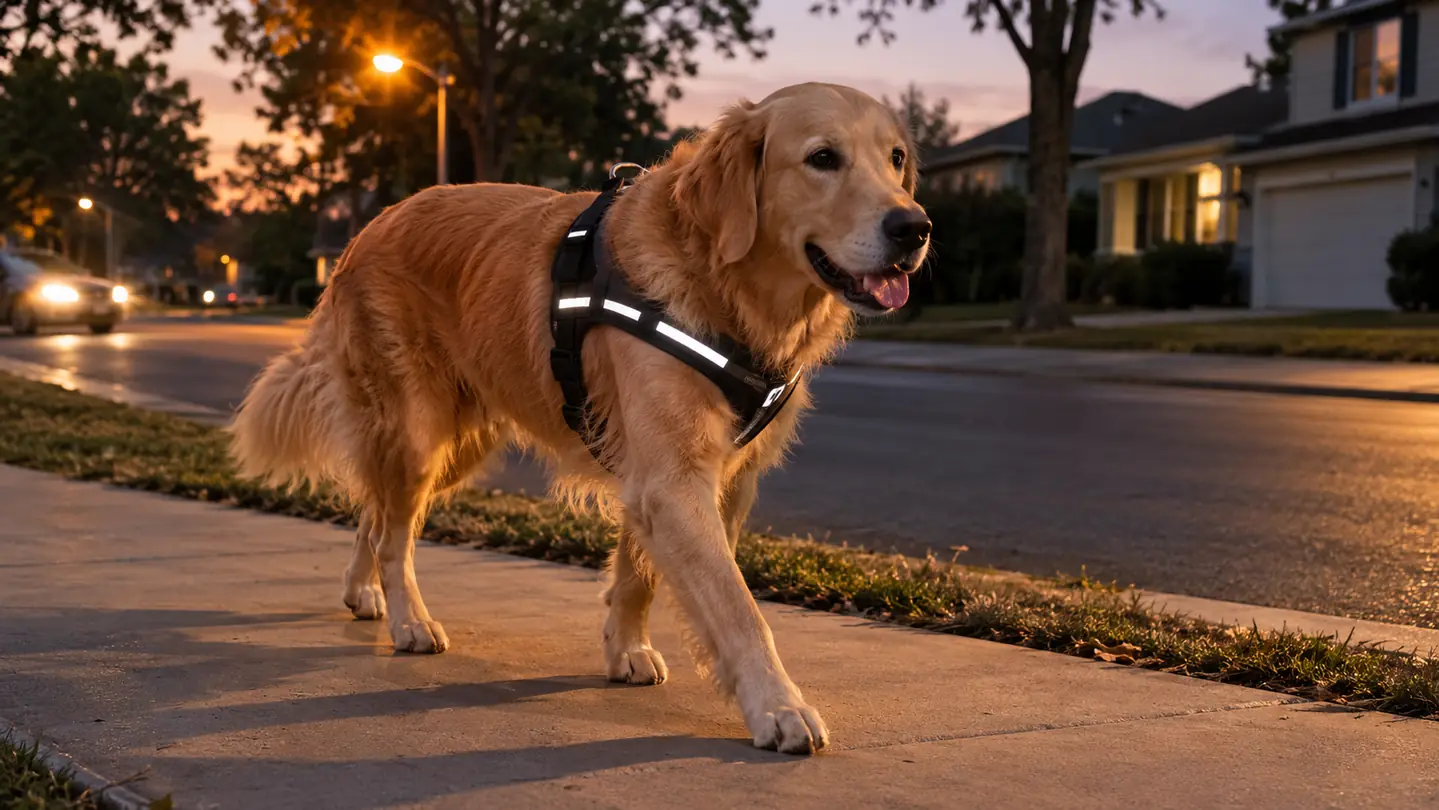
The reflective strips are stitched in along the sides and the back, and they still catch a headlight. I walk Murphy at 6:30 in the morning for most of the year, and in December that means dark. I tested the strips by standing in my driveway with a flashlight and they throw the light back at you. That is not why I bought the rabbitgoo harness, but it is why I stopped worrying about the early walk.
What It Does Not Fix
It does not fix the dog. Murphy is scent-driven, and he is going to lean toward a mailbox whether he is wearing a harness or a paper bag. What this harness did was take away his ability to turn a lean into a lunge that takes me with him. I still have to pay attention. I still shorten the leash when I see a squirrel, and I still plant my feet at the corners where the rabbits cross.
What it also does not do is teach your dog anything. After a few weeks Murphy had stopped lunging, but he had not stopped wanting the smell. The harness makes a bad habit survivable. It is not training, and I would not want anyone to buy it thinking the problem is solved and stop paying attention. I still watch the corners. I still shorten the leash when I see another dog coming, and I still cross the street when the mail truck is on our block, because Murphy has strong opinions about the mail truck.
It also does nothing about the noise. Murphy is a beagle mix, so he bays. When he catches a scent he cannot get to, he tells the entire neighborhood about it, and no harness on the market is going to change that. The rabbitgoo stopped the choking and the wheezing. It did not stop the singing.
What I Liked
- Front clip turned hard lunges into a sideways step within about two weeks
- Metal hook loops front and back, no visible wear after eight months of twice-daily walks
- Four adjustable straps let me fit a deep-chested 28 pound dog
- Reflective strips still throw light back after roughly eight hand washes
- Washes in the sink and air dries overnight
Where It Falls Short
- The front clip pulls him in a slow circle when he ranges out on a longer line
- Straps picked up fuzz where the leash rubs
- Belly panel stays dingy no matter how often I wash it
- Loose strap ends flap unless you knot or tuck them
- Needed two small strap re-adjustments after hand washing
By the second week the jolt was gone. It is a lean now instead of a lunge, and I can hold it one-handed without bracing.
Who This Is For
If you walk a dog in the twenty to thirty pound range who lunges when he catches a scent, this is the harness I would point you to. It suits a dog who is strong for his size, the kind who can wrench your arm sideways before you know he has scented something. It suits an owner who is not as young as she used to be and does not want to spend the next ten years bracing against a leash. It also suits anyone who walks the same dog in two different modes, a tight neighborhood sidewalk and a looser park trail, because the two clips cover both without changing gear. And it suits someone who would rather wash the thing in a sink than run a whole load of laundry for one harness.
Who Should Skip It
If your dog has already learned to back out of a vest, I would not count on this one being different. It is a vest style with a buckle closure, and a dog who knows how to slip a vest is a different problem than a pulling problem, and probably one for a trainer rather than for a product. If your dog is a serious hard puller, the kind who has actually taken you off your feet, a front clip harness gives you steering, not a brake, and it is not a substitute for working with someone. And if your dog is a chewer, do not leave it on him around the house. Murphy has never gone after a strap, but he has his own things to chew and I do not test my luck.
One more thing, and this is the part I would say over the fence rather than in a review: if your dog is coughing, wheezing, or making a noise on the leash that worries you, that is a question for our vet, not for a harness. The gear came after the advice in our house, not instead of it.
Eight months on, it is still the harness on the hook by my back door
Front clip for the neighborhood, back clip for the park, four straps to fit it to your dog. We followed the size chart to get there. Check today's price on Amazon before your next walk.
Amazon Check Today's Price on Amazon →