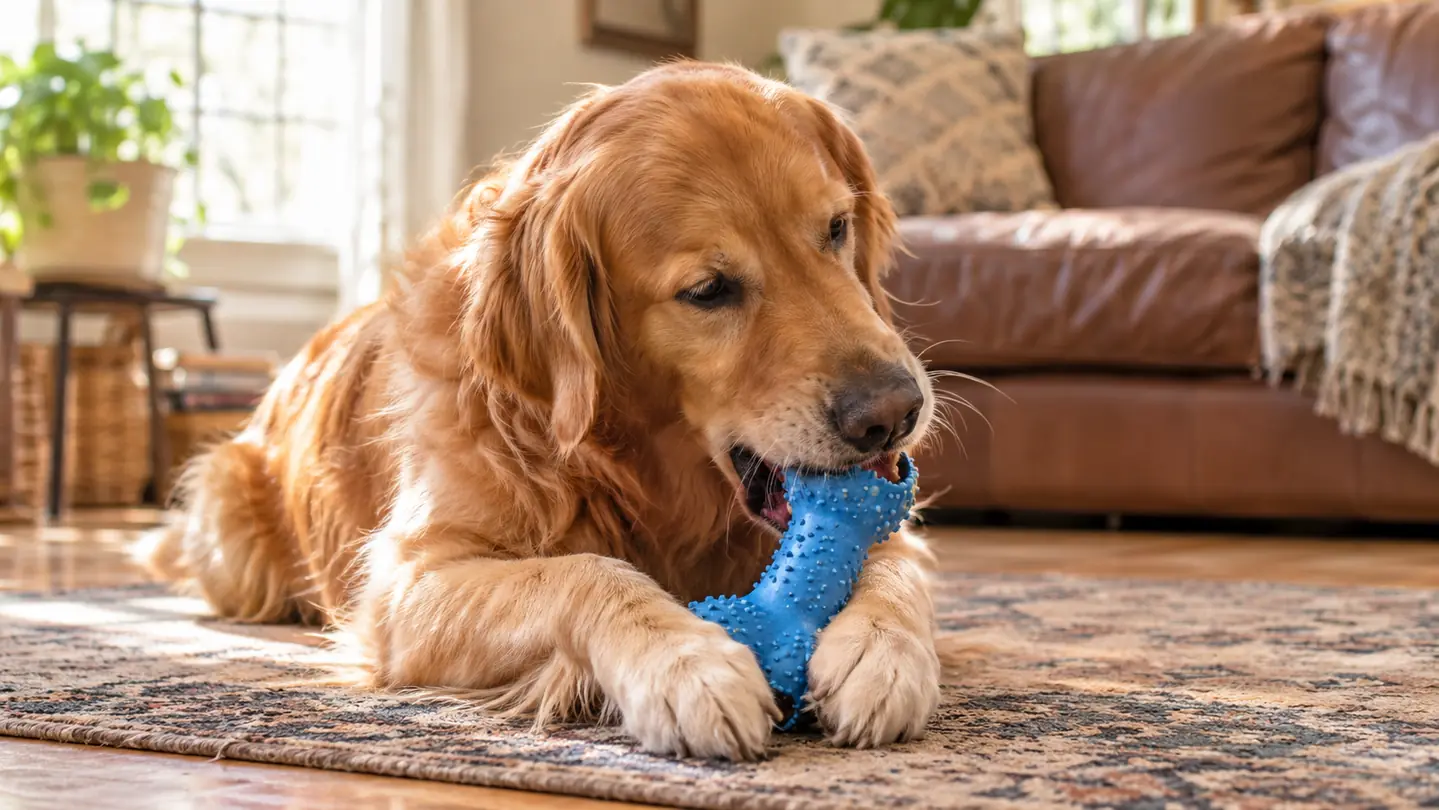
Two years ago I came downstairs on a Tuesday morning and found sawdust on the kitchen floor. Murphy was lying beside the table with his chin on his paws, looking like he had no idea how a fresh notch got into the leg. He was four then. He is six now, a 28 pound beagle mix with a nose that runs his whole life, and he still loves to chew. What changed is not the dog. It is what I put in front of him.
I am not a trainer and I am not a vet. I am a retired school bus driver in Toms River with a fenced back yard, a husband named Frank, and a dog who can flatten a plush toy in one evening and then look around for dessert. Before I brought home a Benebone Wishbone in May, Murphy had chewed the legs of my kitchen table and one dining chair, and I had spent more on toys that lasted a day than I care to add up. What follows is the order I did things in. It is also the order I would do them again if I were starting tonight with a different dog.
The chew that finally outlasted my dog
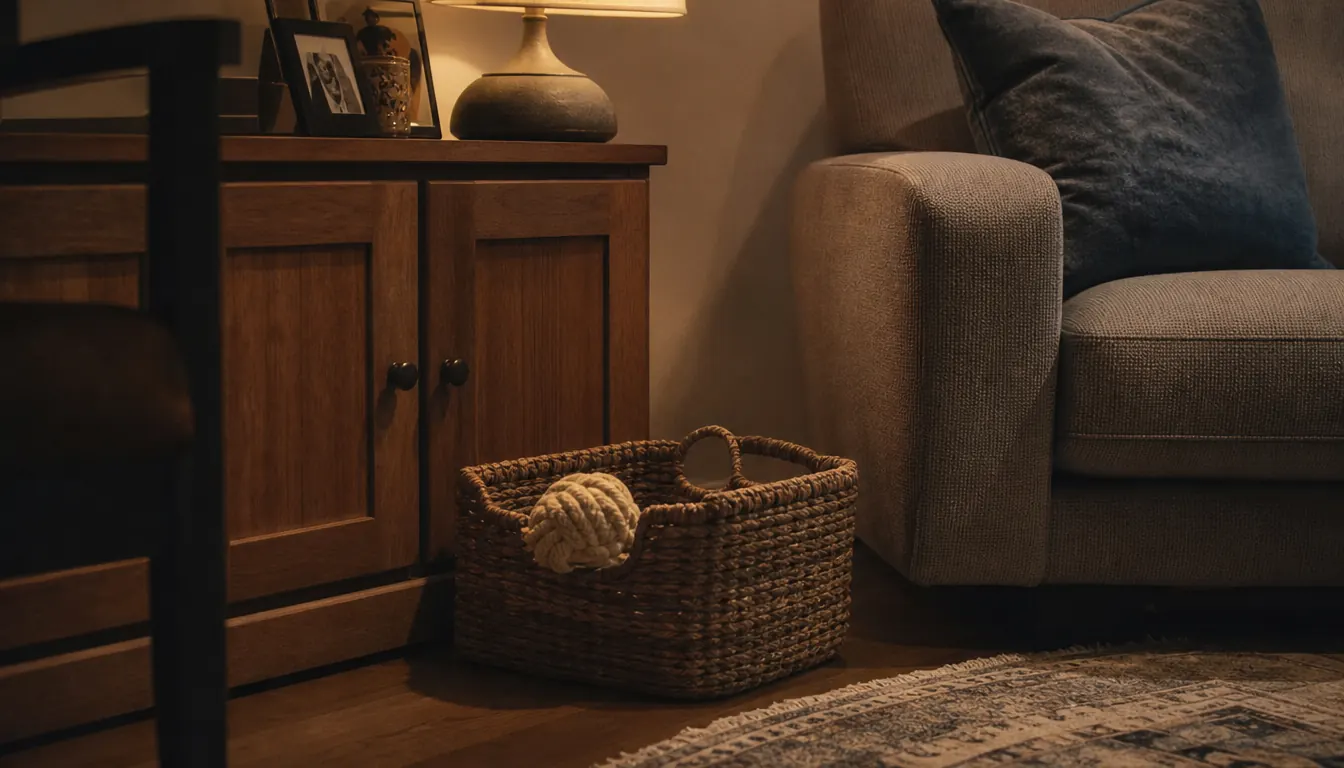
A Medium Benebone Wishbone has been in the basket by my couch since May. The ends are chewed rough. It is still in one piece.
Amazon Check Today's Price on Amazon →Step 1: Find out what he is chewing, and when he does it
For one week I kept a note on the back of an envelope on the kitchen counter. Every time I caught Murphy with something in his mouth that was not his, I wrote down the time and what the thing was. It took about four days to see the pattern. He chewed in the evening, mostly between seven and nine, while Frank and I watched television. He also chewed in the ten minutes after I left the room and before he settled. The table legs and the one dining chair took all of the damage. Baseboards, shoes and the mail were never touched.
That is worth knowing before you buy anything, because it tells you where the problem is coming from. Murphy was not chewing out of mischief. He was chewing because he was awake, bored, and lying on a hardwood floor at the exact hour when nobody was playing with him. A dog with nothing to do at seven at night will find a job. Mine found the furniture.
There is one thing I want to say plainly, because it is the part people skip. If your dog is chewing doors, walls, or his own paws, or if a dog who never chewed suddenly starts at age eight, that is a question for our vet and not a shopping problem. What I am talking about here is a healthy dog with a mouth and no plan.
Step 2: Make the old targets boring
I tried the spray first. A bitter spray on the table leg, two coats, exactly as the bottle said, and I stood there feeling like I had solved something. Murphy licked it off and went back to work. Some dogs are put off by the taste. Mine treated it like a sauce.
So I did it the dull way. I pushed the dining chairs in under the table every single time we got up, which is a small thing I still do without thinking. I put a cheap wooden stool in front of the spot on the table leg he liked best, turned so the flat side faced out and there was nothing to get a grip on. I moved an old blanket and his water bowl into the corner of the living room where he could see the whole room and the doorway, because a dog who is watching the house is not chewing the table.
None of that fixes anything on its own. What it does is take the fun out of the wrong choice and buy you the two or three seconds you need to make the right one. The right one is the next step, and it does not work if the wrong one is still sitting there smelling like a hobby.
Step 3: Pick a chew that outlasts the dog
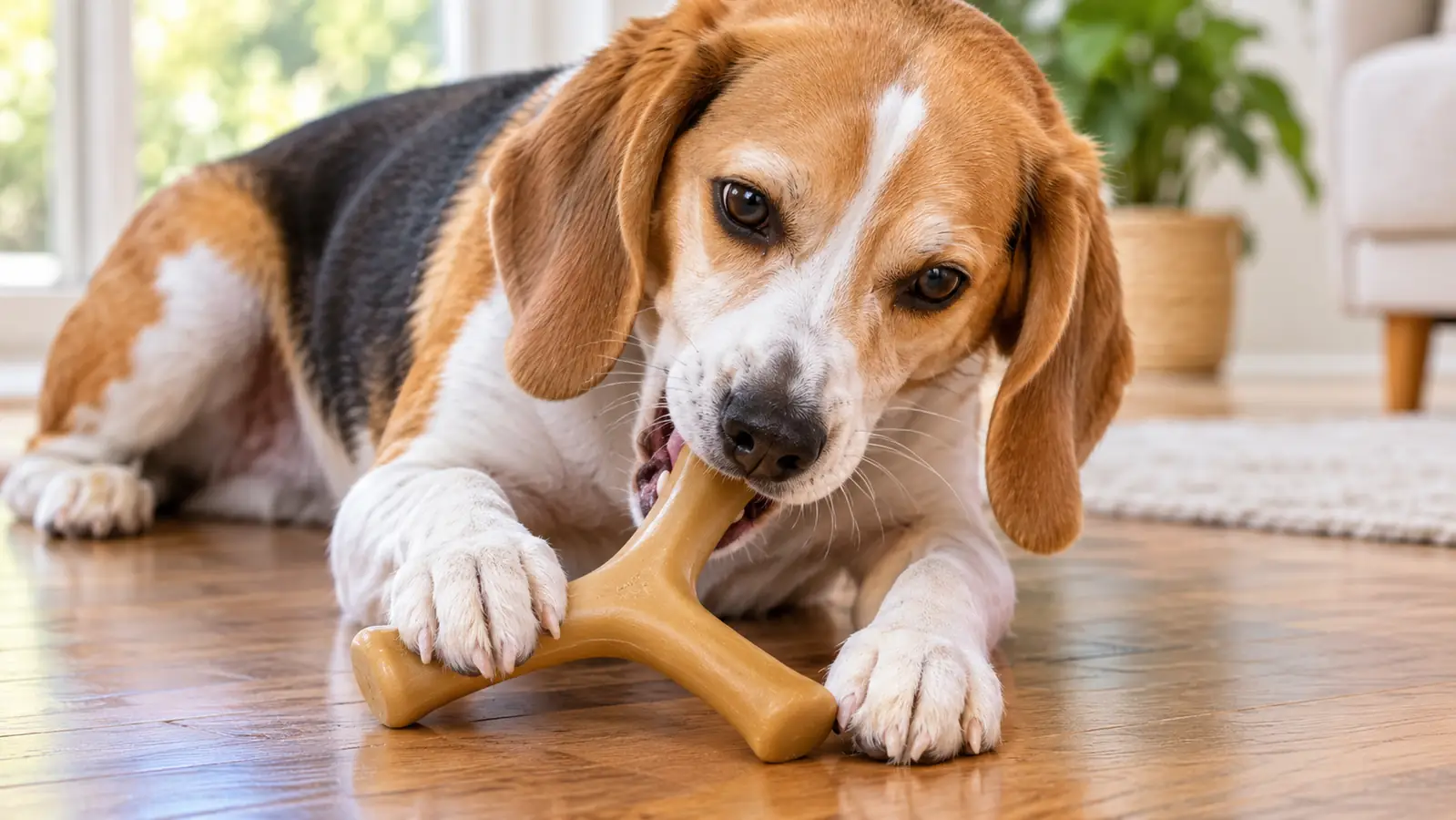
This is where I stopped guessing. In May I bought the Benebone Wishbone in Medium, chicken flavor, after the fourth plush toy in a month came apart on the living room rug. The listing calls it heavy duty, and the shape is the reason I picked it over a stick or a bone. It is curved so a dog can pin one end with a paw and get a real grip on the other, which is exactly what Murphy does with it. It measures about 6.69 by 4.72 by 1.18 inches and weighs around 6 ounces, so it is a serious piece of material in the mouth of a 28 pound dog. The flavor is infused real chicken, which the listing makes a point of. It is also made in America, which I did not expect and did like.
I also stopped leaving it out all day. Murphy gets the Wishbone in the evening now, and the rest of the time it lives in the basket by the couch. A chew that is always available becomes wallpaper, and a dog will walk right past wallpaper to get to a table leg. A chew that shows up at seven at night is the best thing in the room. Six months in, both ends are chewed rough and slightly flattened, the middle is still solid, and it has not splintered or come apart.
What I have learned is that size matters more than the name on the box. Too small and the dog works it down to a nub in a week. Too big and a smaller dog cannot get a grip and gives up on it. Medium suits Murphy at 28 pounds and it is the size I would buy again tomorrow. Buy the size that matches the dog in front of you, not the size you hope will last longer.
Step 4: Hand it over at the right moment
The first few weeks I got this backwards. I would wait until Murphy was already working on a table leg, pull him off, and hand him the chew. That teaches a dog that chewing the table is the thing that makes the good chew appear. It is the opposite of what you want. What worked was catching him before he started, at about ten to seven, and setting the Wishbone down on the rug while he was still standing there with nothing to do and no better offer.
When I did catch him on the furniture, I did not scold him. I said his name, waited for him to look up at me, and traded. Table leg for chew, every time, no exceptions, no matter how tired I was. He is not a stupid dog, and it took maybe two weeks before he started going to the basket on his own after dinner. Frank says I trained the dog and the dog trained me and we are both right.
One thing I will not budge on is supervision. The label says to supervise, and I have heard enough stories about a dog working a piece loose to take that seriously. Murphy chews on the rug at my feet while we watch television. He does not get the Wishbone in the yard alone, and he does not get it when we leave the house. That is not a comment on the toy. That is a comment on dogs.
Step 5: Check it every week and know when to let it go
Every Sunday I pick it up and look at it in the light from the window. Six months in, the ends are rough and flattened, the middle is solid, and the shape is still a wishbone. That is a worn chew, which is what a chew is supposed to be. What I am actually looking for is different: any part small enough that he could get it off in one piece, a surface breaking into flakes or sharp edges, or enough missing mass that the shape has changed. Any of those and it goes in the trash that day.
I would rather replace a chew than a chair, and I would certainly rather replace a chew than spend an afternoon at the emergency clinic. That is the whole equation. It is a chew, and it is doing a job. When it stops doing the job safely, it is done, and I do not need to squeeze another month out of it.
One more thing, and this one surprised me. I only have the one Wishbone. I thought about buying a second so there would always be one that was clean and waiting, and then I realized a basket full of chews is the same as a basket full of wallpaper. One is enough. It has a job and it does it.
What Else Helps
A chew works better on a tired dog, and I did not appreciate that until a week when the walks got rained out. Murphy gets two walks a day, about half an hour each around the neighborhood, and a longer one at the county park on the weekend where his nose gets a real workout and he comes home and sleeps. On the days we skip one, the evening chewing is harder and he goes back to the Wishbone sooner and with more effort. That is not a coincidence, and no toy fixes it.
A cardboard box with a few pieces of kibble tucked into the flaps keeps him busy longer than anything I have bought for him, and it takes ten seconds to put together. His nose is the strongest thing about him, and giving it a job settles him faster than a chew does.
One more habit that helped: I feed Murphy at five, and the chewing hour is seven, so by the time the Wishbone comes out he has had dinner and a walk and he is ready to lie down with something. If your dog's chewing hour lands right after a meal, try moving the chew to after the walk instead and see whether it makes a difference. It did here.
A neighbor of mine gives her lab a Nylabone Power Chew and swears by it, and I have no argument with her. I have never used one, so I am not going to pretend I can compare the two from my own kitchen. What I can tell you is that the Wishbone is the one that has lasted six months in this house, through a beagle mix who treats every object in the room as a suggestion.
What did not help, in case you are tempted: the bitter spray, the plush toys, and the week I moved the dining chairs across the room and then put them back because we needed to eat dinner. Consistency is boring and it is the entire job.
Six months on one Medium Wishbone, the ends chewed rough and the middle still solid, and my kitchen table has not grown a new notch since May.
If You Are Starting Tonight
If I were starting over tonight with a dog who eats furniture, I would do it in this order. Find the hour when the chewing happens. Make the furniture a bad grip. Put a heavy duty chew in the room before that hour starts, not after it. Trade every single time you catch him, and say nothing else about it. Then check the chew on a schedule you can actually remember, and let it go when it wears out.
It took about two weeks for the evening chewing to move off my table legs and onto the Wishbone. It has stayed there for six months. That is not a dramatic story and nobody is going to make a movie about it, but my dining set survived and my dog has something to do at seven at night, and that is what I was after.
One chew, six months, and a table with no new notches
Medium Benebone Wishbone, real chicken flavor. Rough on the ends, still whole, still in the basket by the couch.
Amazon Check Today's Price on Amazon →