
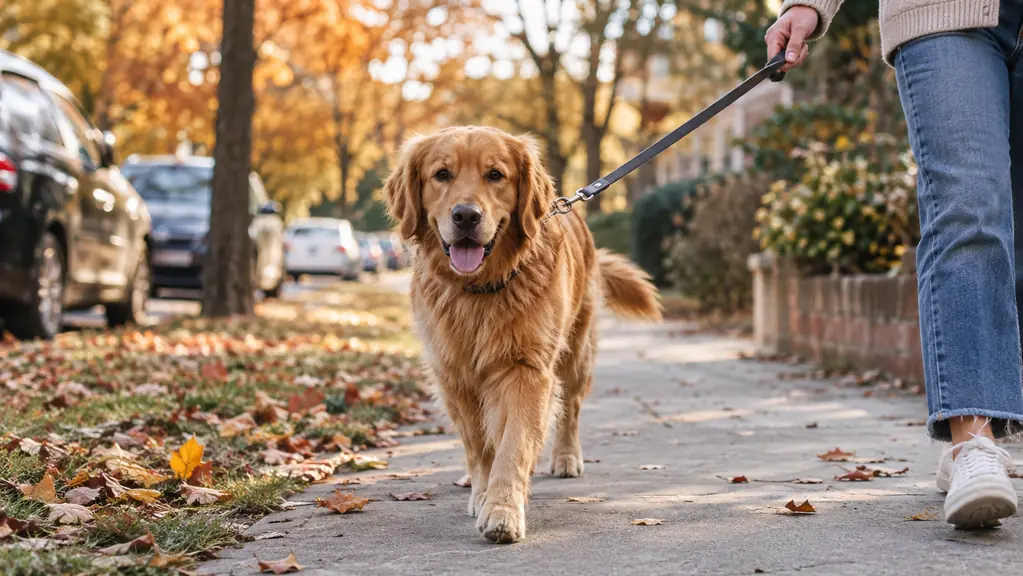
Murphy is a 6-year-old beagle mix, about 28 pounds, and for the first four years I had him, every walk was a negotiation he won. A squirrel at the end of the block, a scent on a mailbox post, somebody's dropped sandwich near the curb, and he would hit the end of the leash hard enough to make himself wheeze.
The problem was never that he was a bad dog. The problem was the flat buckle collar he wore. Every lunge pulled that collar straight across his throat, he made a rasping sound I could hear from three houses away, and I would jerk him back and we would both be sour by the time we reached the corner. My shoulder ached after walks. I am 63 years old. That ache is not nothing.
In March 2026 I bought a rabbitgoo No Pull Dog Harness in size Medium. I want to be honest about what changed, because a harness is not magic and anybody who tells you it is has not walked a beagle. Most of the improvement came from how I used the rabbitgoo harness, not from the box it arrived in. Eight months later it hangs on a hook by the back door with the leash, and here is the routine I would follow again from day one.
The front clip is the part that changed my shoulder
Murphy has worn the rabbitgoo harness on two walks a day since March. Size Medium, four adjustable straps, two metal leash loops, reflective strips for the early walks before sunrise.
Amazon Check Today's Price on Amazon →Step 1: Fit It Before You Judge It
The first week I had it, I nearly sent it back. The straps were loose, the chest piece sat too low, and Murphy walked like he was wearing a paper bag. Then I actually read the size chart instead of eyeballing it and took five minutes to adjust all four straps.
There are four adjustable straps on this harness, and the Medium is listed for a chest of 15 to 27.8 inches. We followed the size chart and it was right. You want two fingers of room under each strap, no more. Too loose and the whole thing rotates when the dog pulls, which defeats the point. Too tight and you get a dog who plants his feet at the door and refuses to move, which is exactly what Murphy did the one time I overcorrected.
Get it right once, then leave it alone. I check the fit on the rabbitgoo harness every couple of weeks and I look over the buckles each time I put it on. Four years of shelter dog has taught me to check the hardware before I trust it.
The buckle takes a few seconds to get used to, especially with a dog who is excited. Murphy figured out inside a week that standing still while I fasten it earns him a treat, and now he stands at the door and waits. Small thing, but it means I am not wrestling a beagle on the front step at seven in the morning.
Step 2: Front Clip on the Street, Back Clip at the Park
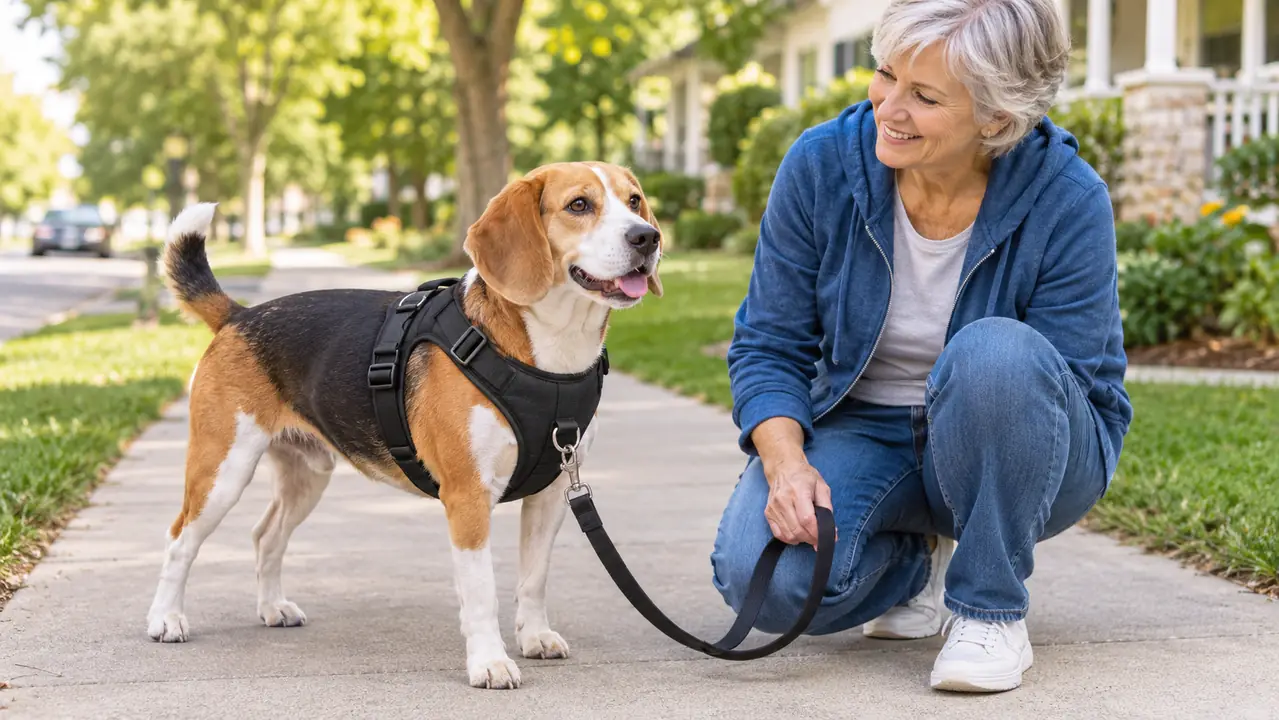
The rabbitgoo harness has two metal hook loops for the leash, one at the chest and one across the back. That is the whole reason I bought it and I suspect it is the reason most people buy it. On our neighborhood walks, the leash goes on the front chest loop. When Murphy pulls forward, the clip turns him slightly to the side instead of letting him lean his whole weight into the pull, and he loses the argument with himself instead of with me.
At the county park on weekends, I move the leash to the back loop. The front clip is a steering tool and steering is not what I want when we are out on grass with room to roam. The back clip lets him keep his nose down and wander a bit without the harness correcting every step. Same harness, two different jobs, and it takes about four seconds to switch.
One thing I got wrong at first: I kept clipping to the front on the park walks, and Murphy spent a whole hour being turned sideways every time he found something interesting. He was not pulling. He was being steered into a circle. Read the walk, not the harness.
There is one more thing about the front clip that nobody told me. With the leash on the chest loop, you cannot give a lot of slack, because the clip sits low and the line can slip under a front leg if the dog spins. I keep it short on the street. That is part of why the front clip works so well, and part of why I do not use it at the park.
Step 3: Let the Pressure Teach, Not Your Arm
Here is the part that took me the longest to learn, and I am not a trainer, so take it as one dog owner telling another what worked. When Murphy hits the end of the leash, I stop. Not a yank, not a correction, just stop moving. The harness holds him back on its own, and after a second or two he turns around to see why the walk quit.
Then I wait. When the leash goes slack, I say his name and we go again. That is the entire lesson. Pressure means the walk stops, slack means the walk continues. It took about two weeks of this before the hard lunges dropped off. Two weeks of standing still on the same sidewalk while the neighbors walked past me, which is its own kind of humility.
He still pulls when he catches a strong scent. I want to be straight about that, because a beagle's nose is not something you train out of a dog and I would not want to try. It is a lean now, not a lunge. The rabbitgoo harness gives me something to hold that is not his windpipe, and I can wait out a lean. I could not wait out a lunge.
The other change was in me. I used to walk Murphy with my arm locked straight out, braced, waiting for the next lunge. Now I hold the leash with a loose hand and let the front clip do the work. My shoulder stopped aching after walks inside the first month. That is not a medical claim, it is just what happened when I stopped arm wrestling a beagle four times a day.

Step 4: Practice Somewhere Boring First
The mistake I made with the old collar was testing everything at once. The first walk in the new harness was our usual route at 7 a.m. with the school bus running and a landscaper's leaf blower going, and it went badly. So I backed up. For a week we walked the same two blocks of our own street, back and forth, nothing much to smell and nobody to meet.
Boring is the point. You are not teaching the dog to walk politely in a crowd. You are teaching him what the pressure on his chest means, and that lesson goes in faster when nothing else is competing for his attention. Once he was giving me slack on our own block, we moved to the busier street. Once that worked, we went back to the full route.
I also learned to watch Murphy's tail instead of his head. Head down means he is tracking and a stop is coming. Tail up and stiff means he has spotted something and I have about one second. You learn your own dog's tells, and the harness gives you a way to hold the line while you learn them.
The reflective strips on the rabbitgoo harness ended up mattering more than I expected. Our first walk is before sunrise in the winter, and the strip across the chest catches headlights from a good distance. It is not the reason I bought the thing, but it is the reason I stopped dreading the early walk.
Step 5: Quit While the Walk Is Still Good
This is the advice I would give a friend at the fence. Most of us walk too long. If the dog is doing well, we keep going to get our money's worth, and then he gets tired and sloppy and starts dragging again, and we finish the walk irritated with each other. End it early instead. Ten good minutes beats thirty minutes of a dog hauling you down the street.
For the first month, I turned us around at the corner whether Murphy wanted to or not. He got praised, he got a treat, and we went home with slack in the leash. Now we do our full thirty minutes twice a day and the longer weekend walk at the park, and most of it is easy. Not perfect. Easy.
The harness gets washed by hand in the sink about once a month and air dried on the back step. Eight months in, the mesh is still intact and the straps have not frayed, though the metal loops have dulled some from the leash clip rubbing against them.
And take it off when you get home. Murphy sleeps in the living room and I do not leave gear on him when we are not walking. The rabbitgoo harness goes on the hook by the back door with the leash, which is also how I remember where both of them are.
What Else Helps
A six foot leash, not a retractable one. A retractable leash teaches a dog that pulling earns him more room, which is the opposite of what you are trying to teach. Ours lives in a drawer now.
Treats in a pocket you can reach with one hand. Murphy will do a lot for a piece of freeze dried liver and nothing at all for a plain biscuit when there is a squirrel involved.
Consistency, mostly from Frank. My husband retired two years ago and he takes the afternoon walk. If one of us lets the pulling work and the other one does not, the dog learns to gamble, and the dog always wins that gamble. We had to agree on the stopping rule out loud, in the kitchen, like two people settling a treaty.
A word about the rest of the gear. I have bought a lot of things for this dog over four years and most of it does exactly one job. The bed is for sleeping. The chew bone is for chewing. The slow feeder is for dinner. None of that helps with pulling. If you are standing in your kitchen at night wondering which purchase to make first, make it the one that fixes the thing that happens twice a day, every day.
And check the fit again when the seasons change. Murphy's coat thickens up in the fall and I let the chest straps out one notch in October, then took them back in come spring. A harness that fit perfectly in June can sit too snug by Thanksgiving, and a snug harness on a dog who is already unsure is how you end up with one who sulks at the door.
And if your dog is limping, or yelping when he turns, or dragging a back leg, that is not a training problem and a harness will not fix it. That goes to our vet, not to me and not to a product page.
Two weeks of standing still on the same sidewalk while the neighbors walked past me, and the lunging stopped. The harness was not the teacher. The stopping was.
Eight months, two walks a day, one harness still on the hook
Size Medium fits a chest of 15 to 27.8 inches. Four adjustable straps, two metal leash loops, breathable mesh, reflective strips, and a warranty for quality issues. We followed the size chart and it held up through a Jersey winter.
Amazon See the rabbitgoo No Pull Harness on Amazon →