

You can wash an orthopedic dog bed. You just cannot wash all of it at once. That distinction cost me ten minutes of standing in the laundry room holding a bed that was never going to fit in the drum, and it is the thing nobody mentions when you buy one. The cover comes off. The foam stays dry. Everything past that is detail, and the details are where people wreck a perfectly good bed in the first month.
Murphy is my beagle mix. He is six, about 28 pounds, tan and white with a black saddle, and he came home from a local shelter four years ago with a nose that runs this entire household. The Bedsure orthopedic dog bed, the medium 28 inch one, has lived in the corner of our living room by the window since July. That is four months now. The cover has been through the machine three times on cold and air dried every time, and the foam insert has never been wet. That is the whole method. What follows is the order I actually do it in, including the part I got wrong the first time.
The cover zips off. That is the entire reason this bed survives a shedding dog.
Bedsure orthopedic dog bed, medium 28 inch, foam insert inside a removable cover that goes in the machine on cold. Rated to 30 pounds. Murphy is 28. Today's price is on the listing.
Amazon Check Today's Price on Amazon →Why the Foam Is the Part You Have to Protect
An orthopedic bed is not a pillow with a fancy name. The support comes from the foam core, and the foam core is the one part of the bed that cannot be washed back to health once it goes bad. Ours is five pounds of it, 6.5 inches thick in the middle, with raised bolsters on four sides. The fabric around it comes off and goes in the wash. The foam can only be protected.
That is why every step below circles back to one rule. Water goes on the cover, never on the foam. People ruin these beds by treating them like a mattress topper and hosing the whole thing down in the driveway, or by stuffing the whole bed into a machine because the listing said washable and they stopped reading there. Washable means the cover. It has always meant the cover.
There is a second reason to keep that core dry, and it is not really about the foam at all. A damp core smells. It smells worse than the dog did, and it smells in a way that washing the cover cannot fix, because the smell is in the middle of the bed and the middle of the bed does not come out. You cannot launder your way out of a wet insert. You can only avoid making one.
Step 1: Read the tag and know what comes apart
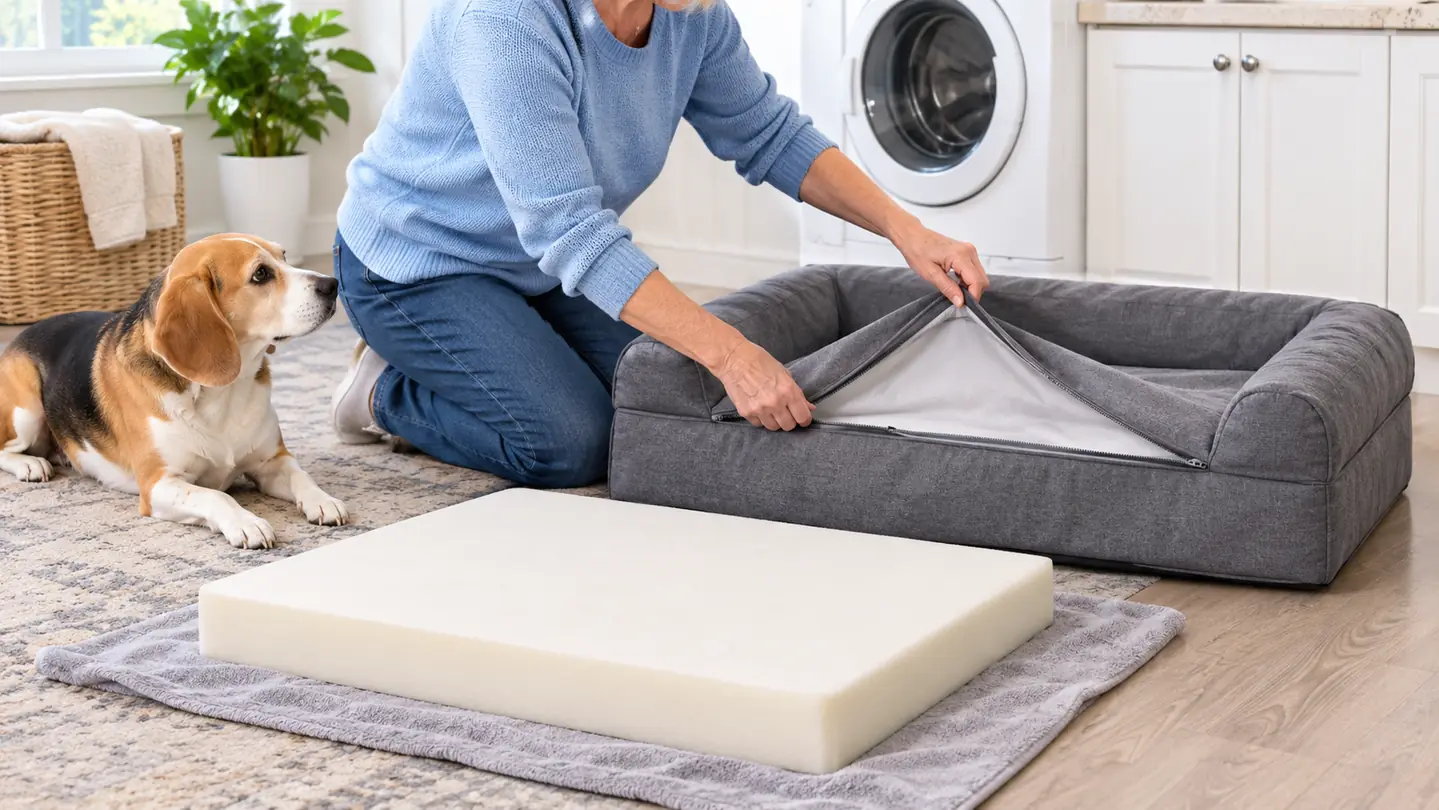
Before anything gets carried downstairs, look at the bed and figure out what separates. On the Bedsure medium, the cover unzips and lifts off the foam insert. That is the whole disassembly. There are no inner liners to hunt for, no buttons, no ties to unknot while the dog watches you like you are stealing his furniture.
The specs on ours read 28 inches long, 23 inches wide, about 6.5 inches thick, five pounds, foam fill, cover listed as removable and waterproof, maximum weight 30 pounds. I only care about two of those numbers on laundry day. The thickness, because a thick insert is a thick thing to wrestle a cover back over. And the weight limit, because a bed that spends its life over its limit goes flat and stays flat.
If your tag says something different from what I do here, trust the tag over me. I am not a laundry scientist. I am a retired school bus driver in Toms River with a beagle mix, a washing machine that is older than my marriage, and four months of doing this the same way every time without wrecking anything yet.
Step 2: Take the cover off outdoors and shake it out first
Unzip the cover all the way around, work the foam out slowly, and set the foam somewhere it will not get stepped on. Mine goes out on the porch bench while I deal with the fabric. Then take the cover outside and shake it hard, away from the door.
The amount of hair that comes out of that cover before it ever reaches the machine will surprise you. A beagle mix sheds year round and Murphy is no exception. If you skip the shake, all of that goes into your washer and then onto whatever you wash next, which in my case was a load of Frank's shirts. That was August. I have not skipped the shake since.
The first wash was in July, the week the bed came out of the box, and I shook that cover over the patio and then swept up what came off it. It filled a good part of a dustpan. That was four days of Murphy sleeping on the thing. Four days. He is not a dog you would call a heavy shedder to look at him, and the cover still looked like a beagle had been combed onto it. That was the day I stopped guessing and started shaking it out every single time.
Turn the cover inside out and shake it a second time. Grit collects on the inside, the sand from the county park, crumbs, whatever he ground in with his elbows over the course of a week. Two good shakes over the patio, then it goes in the machine.
Step 3: Wash the cover alone, on cold, on a gentle cycle
Cold water. Gentle cycle. Nothing else in the drum. A cover that size balled up with a load of towels does not get clean, and it does get twisted, and then you are standing there pulling a damp pretzel of fabric apart trying to find the zipper.
Regular detergent, a normal amount. No bleach. No fabric softener, which leaves a film on the fabric and does the cover no favors. I zip the cover about halfway closed before it goes in, so the zipper does not catch on the drum or on itself. It comes out damp and a little wrinkled and that is exactly what you want it to do.
If there is a spot that needs attention, a muddy paw print or something worse, treat it before the wash with a little detergent and a soft brush, let it sit ten minutes, then wash as usual. Do not scrub at it like you are trying to get a stain out of a shirt you love. The fabric on these beds is durable, but it is not armor, and a scrubbed spot goes fuzzy and stays fuzzy.
Three washes on cold, three air dries, and the zipper still runs like it did in July. The foam insert has never been wet and I intend to keep it that way.

Step 4: Air dry the cover and leave the dryer out of it
Hang the cover over the back of a chair or over the porch rail and walk away. Flip it once halfway through. In fall in New Jersey that is most of a day, longer if it is humid, and there is no shortcut that does not involve heat.
One wash I got impatient and draped it over the back of a kitchen chair right in front of the heat vent in the dining room, thinking the warm air would hurry it along. It dried all right. It also came out stiff along one seam, and that seam took another day and a half of hanging before it softened back up to normal. The porch rail gets it just as dry without any of that. In November I move the chair to the sunny side of the porch and it is ready by dinnertime.
Skip the dryer entirely. Not on low, not on air fluff if you can help it. Heat is what shrinks a cover and heat is what makes a zipper stop running true. A cover that has shrunk even a little is a fight to get back over a thick foam core, and there is no reason on earth to sign up for that on a Saturday afternoon.
And do not put it back on the insert while it is still damp. Damp fabric against foam traps moisture in the middle of the bed, which is how you end up with a smell that no amount of washing fixes. Bone dry first. Then reassemble.
Step 5: Clean the foam insert without ever soaking it
The insert does not go in the water. Not the machine, not the bathtub, not the hose in the back yard. Foam that thick holds water for days, and foam that stays damp is foam you will end up carrying out to the curb. There is no repair for that and no clever trick that brings it back.
What I do instead is vacuum it. The upholstery brush on the vacuum, both sides, working down into the bolsters where the hair hides and the vacuum hose does not want to reach. The first time I tried it I used the flat attachment and got almost nothing for my trouble, because a flat nozzle slides right over the surface instead of lifting the hair off it. The brush is the one that works. Two passes, one on each side, and then a third over the bolster seams, because that is where it all gathers.
If there is a spot, a damp cloth with a drop of mild soap, blot it, do not soak it, then let it air out on the porch out of direct sun for twenty minutes or so. While the cover finishes drying, flip the insert over. Ours has a slight dip where Murphy curls up, four months in, and that is normal for foam under a dog who sleeps in the same spot every night. Flipping spreads the wear. Then put it all back together only when everything is dry, zip it shut, and set it in the same corner it always sits in, because a dog with a spot does not care to have his spot moved.
What Else Helps
Most of keeping a bed clean happens before the bed gets dirty. I brush Murphy twice a week with the FURminator, about ten minutes on the back patio, and the hair that ends up on that bed drops noticeably when I stay on top of it. Less hair going in means less hair to shake out on laundry day. The Bedsure cover is the part that takes the beating, and brushing is what keeps it from taking quite so much of one.
There is a towel by the back door for wet paws, especially after the long weekend walks at the county park. After that stretch of rain in October, when the path was more mud than gravel, Murphy came in with all four paws caked and headed straight for the bed the way he always does. Two minutes of wiping and one damp spot on the cover that dried on its own before I had my boots off. Fifteen seconds of towel work beats a whole wash any day.
So does getting the cover off the same day after a spilled water bowl, rather than letting it sit until the weekend.
The listing calls the cover waterproof, and for the small stuff, a wet paw, a tipped bowl, that has held up for us. I would not treat it as a promise about a full accident at two in the morning. If that happens, cover off, into the wash that day, foam checked and aired before it goes back together.
And wash it when it needs it, not because a certain number of weeks have gone by. Ours has been three times in four months, roughly when it starts to smell like dog instead of like laundry. Every wash wears the seams and the zipper a little, and there is no prize for laundering a bed that was still perfectly fine.
Four months, three washes, and the foam has never been wet.
If you want a bed you can actually keep clean instead of one you eventually haul to the curb, this is the one in my living room. Medium 28 inch, removable cover, rated to 30 pounds. Today's price is on the listing.
Amazon Check Today's Price on Amazon →